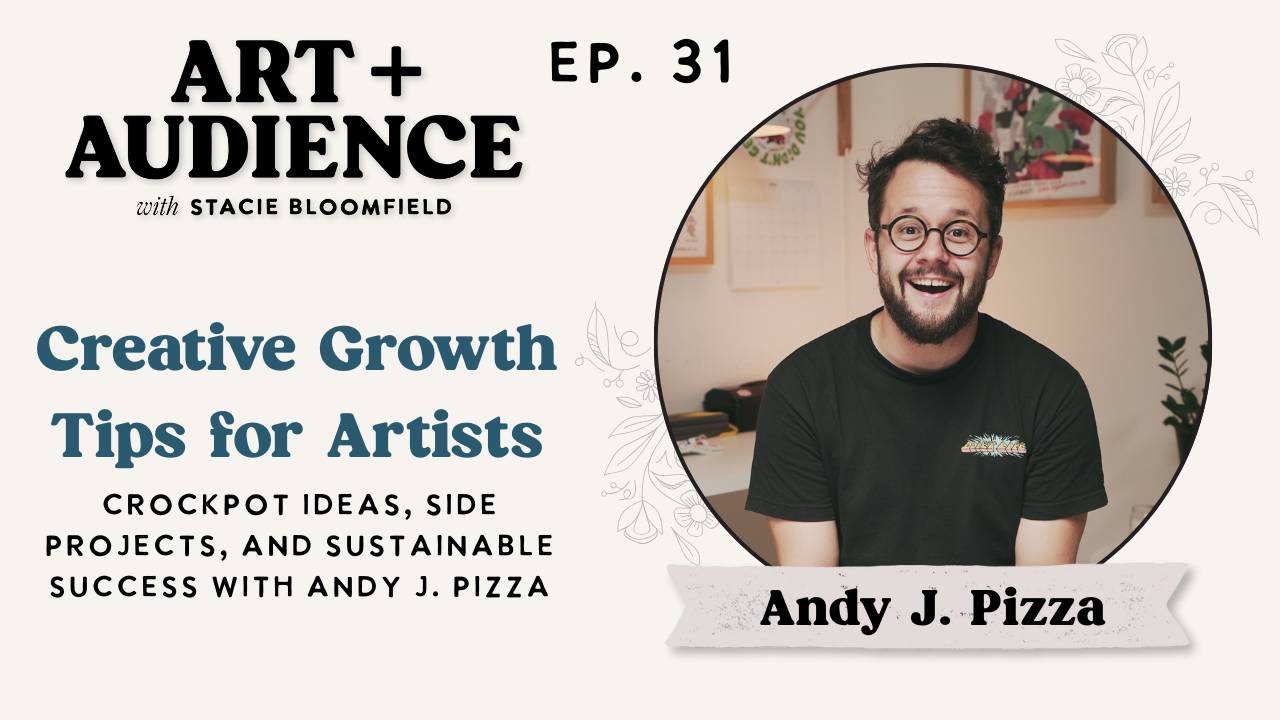
Creative Growth Tips for Artists: Crockpot Ideas, Side Projects, and Sustainable Success with Andy J. Pizza
🎧 Listen to this episode: Apple Podcasts
This is Part 2 of Stacie Bloomfield's conversation with Andy J. Pizza — host of the Creative Pep Talk podcast and one of the most thoughtful voices in creative entrepreneurship. If Part 1 was about understanding yourself as a creative, Part 2 is about what you actually do with that understanding.
In this episode of the Art + Audience podcast, Stacie and Andy go deep on crockpot creativity, the main band vs. side band, plotters vs. pantsers, and why embracing a little structure might be the most rebellious thing a creative person can do. It's equal parts pep talk and practical guide for anyone navigating a sustainable creative career.
Stacie built Gingiber into a $2M+ art licensing brand and has been both the dreamy big-picture thinker and the disciplined executor — sometimes in the same morning. This conversation is a field guide for everyone trying to live in both hemispheres at once.
RESOURCES MENTIONED IN THIS EPISODE:
- Creative Pep Talk Podcast — Andy J. Pizza's show on the creative life, career, and the mindset that makes it sustainable. A must-follow for any working creative.
- The Artist's Side Hustle — Stacie's Hay House book for artists who want to build real income without burning out. Everything this conversation points toward, made practical and actionable. Sold out its first print run in four months.
HERE ARE THE 5 KEY TAKEAWAYS FROM THIS EPISODE:
1️⃣ Whole-Brain Living: You Don't Have to Choose Between Creative and Strategic
Stacie describes what she calls "whole-brain living" — the ability to move fluidly between big-picture dreaming and administrative execution. Not everyone can do this naturally, but it's a skill that can be built, and it's one of the most valuable things a creative entrepreneur can develop.
"I don't feel like the most artistic people look at me as a real enough artist because I care about money," Stacie shares. "But it's not money — it's safety." Caring about the business side of your art doesn't make you less of an artist. It makes you a more sustainable one. The goal isn't to choose between art and strategy. It's to learn to toggle between the two without losing yourself in either.
2️⃣ Plotters vs. Pantsers — And Why You Need Both Modes
Andy introduces one of the episode's most useful frameworks: plotters (people who plan every detail before creating) vs. pantsers (people who fly by the seat of their pants). Both approaches are valid — but for a working creative, knowing which mode you're in and when to switch is essential.
"There's not just one type of creativity," Andy says. "Exploratory creativity starts without knowing where it's going. Strategic creativity starts with the end in mind. Both are important." Small amounts of structure — creative briefs, design constraints, deadlines — can push you out of your comfort zone in ways that pure spontaneity never will. Rejecting structure might just be fear in disguise.
3️⃣ Crockpot Creativity: The Best Ideas Need Time to Simmer
For anyone juggling multiple creative dreams, Andy offers the concept of crockpot creativity: instead of throwing ideas away when the timing isn't right, let them simmer. The crockpot is always on low heat. You revisit it when the season is right.
"I couldn't throw picture books in the trash. But I could put them in the crockpot," Andy explains. Years later, after focusing his energy on his podcast, the picture book deals finally landed. Stacie has a mirror story: she pushed for a picture book opportunity for years, gave up — and that's exactly when the offers came pouring in. Timing matters. Trust matters more. Letting go of the timeline is sometimes the most strategic move you can make.
4️⃣ The Main Band vs. the Side Band — Let Yourself Have Both
Andy's main band is his primary creative focus. His side band is the passion project he tinkers with on the side — lower stakes, more play, no pressure to monetize. The insight is that these two projects actually feed each other.
"When I doubled down on picture books, the podcast got better. When I focused on the podcast, the picture books started flowing. It's about that pulsing rhythm." You can't manufacture a side project's looseness, but you can make space for it to exist. For Stacie, her education work feeds her art practice and vice versa. The permission to have a "side band" — something you love that doesn't need to perform — often makes your main work stronger.
5️⃣ Start Small, Stay Open, and Let It Be Messy
Both Andy and Stacie Bloomfield agree: trying to build a creative career by going from zero to fully monetized immediately only leads to burnout. "If you put all the pressure on yourself immediately to monetize, it won't work," Stacie says.
Some of the best creative breakthroughs come when you let yourself be an amateur again. Stacie's first online course was filmed on an iPad propped on books. It wasn't perfect. But it was real — and it opened the door to everything that followed. Start where you are. Use what you have. Let the first version be imperfect. The crockpot takes care of the rest.
MORE FROM ANDY J. PIZZA
Find Andy and the Creative Pep Talk podcast here:
🌐 Website: andyjpizza.com
🎙 Podcast: Creative Pep Talk — search it on your favorite podcast app
SUBSCRIBE & REVIEW THE ART + AUDIENCE PODCAST
If this episode sparked something for you, the best way to support the show is to subscribe and leave a review on Apple Podcasts. It takes 30 seconds and helps other artists find us. New episodes drop every week — subscribe so you never miss one, and share this with a creative friend who needs to hear it.
Frequently Asked Questions About Creative Growth and Sustainability
What is crockpot creativity and how does it help artists?
Crockpot creativity, a concept from Andy J. Pizza, is the practice of putting ideas you can't pursue right now on "low heat" instead of abandoning them entirely. Rather than forcing every idea to fruition immediately — or discarding it when the timing feels wrong — you let it simmer and return to it when the season is right. This reduces creative pressure and often leads to better work, because the idea has had time to develop naturally.
How do you balance multiple creative projects without burning out?
Think of your projects as a main band and a side band, not competitors for the same energy. Your main focus gets your primary effort; your side project gets whatever you can give it without pressure to perform. Andy J. Pizza and Stacie Bloomfield both found that their "side" projects improved their main work by giving them a creative outlet free from performance expectations. The key is protecting the side project from the pressure to monetize too quickly.
Should artists embrace structure and planning, or does it stifle creativity?
Both — at different times. Andy J. Pizza distinguishes between exploratory creativity (starting without knowing the destination) and strategic creativity (starting with the end in mind). Artists who only embrace one mode limit themselves. The ability to toggle between both — to plan when planning serves you, and to freeform when exploration is needed — is what makes a creative career sustainable long-term. Structure isn't the enemy of creativity. Rigid, fearful resistance to structure often is.
About Stacie Bloomfield
Stacie Bloomfield is the founder of Gingiber, a surface pattern design and art licensing brand she built from her dining room table into a multimillion-dollar business with products in 1,400+ brick-and-mortar stores. She has earned $500K+ through art licensing and has taught 5,000+ artists how to build real income from their work.
She is the author of The Artist's Side Hustle (Hay House), a Moda fabric designer, and the host of the Art + Audience podcast. Her programs — including Side Hustle Society, Leverage Your Art, and the Art Licensing Pitch Playbook — help artists at every stage turn their creativity into consistent income.
StacieBloomfield.com needs the contact information you provide to us to contact you about our products and services. You may unsubscribe from these communications at anytime. See our privacy policy for terms and conditions and to learn how we protect your data.