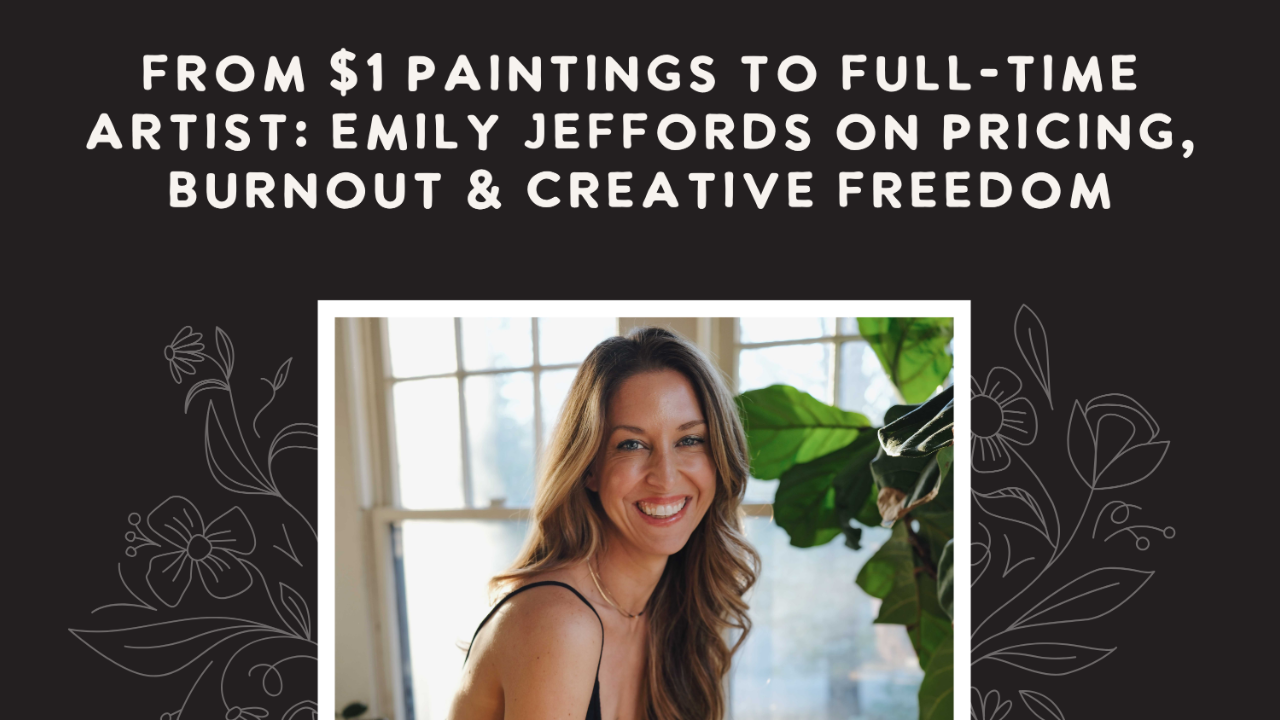
From $1 Paintings to Full-Time Artist: Emily Jeffords on Pricing, Burnout & Creative Freedom
🎧 Listen to this episode: Apple Podcasts
Emily Jeffords sold her first painting for $1. Today she runs a deliberately scaled six-figure studio, has sold more than 1,000 original paintings, and teaches artists how to build careers that don't cost them their health or creative identity. The distance between those two points isn't a lucky break — it's a decade of hard-won clarity about pricing, sustainability, and what creative freedom actually requires.
In this episode, Emily joins Stacie Bloomfield for a deeply honest conversation about the moments that forced her to rethink everything: the pricing mistakes she made early on, the burnout crash that hit in 2021 when her business looked successful from the outside, and the philosophy she's built since then — one that holds both profitability and creative integrity at the same time.
If you've ever underpriced your work, run yourself into the ground chasing growth, or quietly wondered whether a full-time art career is actually sustainable, this episode is for you.
RESOURCES MENTIONED IN THIS EPISODE:
- emilyjeffords.com — Emily's home base for original paintings, prints, and workshops. If this episode sparks something, start here.
- @emily_jeffords on Instagram — 105K followers and counting. Studio process, behind-the-scenes, and the kind of creative honesty this episode is full of.
- The Artist's Side Hustle — Stacie's Hay House book on building real, sustainable income from your art without burning out doing it. Exactly the right companion to this episode.
HERE ARE THE 5 KEY TAKEAWAYS FROM THIS EPISODE:
1️⃣ Pricing Is a Practice, Not a Formula
Emily's first painting sold for $1. That number isn't the point — the point is that pricing is almost never something you figure out once and lock in. It's a practice. A series of small, intentional recalibrations that move you closer to rates that actually reflect the value of what you've made and the life you're trying to sustain.
What kept Emily stuck in underpricing for years wasn't a lack of information. It was a lack of permission — an internal story that said her work wasn't worth more than the market seemed willing to give. The pricing shift happened when she stopped asking "what will people pay?" and started asking "what do I need to charge to keep making work I love?"
If you're undercharging, it's rarely a math problem. It's a worth problem. And the only way through it is to raise the price, ship the work, and let the evidence accumulate that people will pay.
2️⃣ Burnout Is a Signal, Not a Badge
In 2021, Emily's business was thriving by every external measure — more sales, more visibility, more momentum. And she completely crashed. Not because she wasn't grateful or wasn't working hard enough, but because the pace and the shape of her work had stopped fitting the life she actually wanted to live.
Burnout isn't proof you're dedicated. It's a signal that something needs to change — in the structure of your business, the expectations you're carrying, or the story you're telling yourself about what success requires. Emily talks about this with a clarity that's hard to get from someone who hasn't lived through it. She's not afraid of the real version of the story.
The question she came out of 2021 asking isn't "how do I work harder?" It's "what does a sustainable creative life actually look like for me — and am I building toward that?"
3️⃣ 1% Progress a Day Compounds Into Everything
The core mantra inside Emily's MAKING art WORK masterclass: 1% a day. Not a dramatic transformation. Not a viral moment. Just a fraction of improvement, consistently, across a full year. That's the math behind a creative career that lasts.
Most artists quit or plateau because they're measuring growth at the wrong interval. A single week of posting, pitching, or painting doesn't reveal much. A year of showing up with even a small amount of intention looks completely different. Stacie Bloomfield has seen this across the 5,000+ artists she's worked with — the ones who build real income aren't the ones who had the best launch. They're the ones who kept going when it was quiet.
Slow progress is still progress. If it's boring, you're probably doing it right.
4️⃣ Creativity and Commerce Don't Have to Fight Each Other
One of the most common fears among working artists is that building a profitable business will kill the creative part. Emily is living proof that this doesn't have to be true — but it requires intentional design. You have to build a business that has room for the creative life inside it, not the other way around.
That looks different for everyone, but the principle is consistent: don't let the business eat the artist. Keep making work that's just for you. Set boundaries around the commercial work that pays the bills and protect the hours or days that belong to experimentation, play, and exploration with no output attached.
Commerce can fund your creative life. It doesn't have to replace it. The artists who sustain long careers are the ones who figured that out early — or survived long enough to figure it out later.
5️⃣ Real Creative Freedom Requires Actual Unstructured Time
Play isn't a reward for finishing all your work. It's a necessity. Emily is direct about this: unstructured time — with no deliverable, no post, no client, no goal — is where creative energy gets replenished. Without it, you run dry. And dry artists make forced work, which is a slow way to lose the thing that makes your work yours in the first place.
This is one of the hardest things to protect as your business grows, because unstructured time looks like wasted time on the outside. But it's the investment that makes everything else possible — the quality of the work, the staying power, the ability to keep showing up year after year without becoming someone who just fills orders.
Schedule the play. Protect it like a client commitment. The creative work depends on it.
MORE FROM EMILY JEFFORDS
Find Emily and her work here:
🌐 Website: emilyjeffords.com
📸 Instagram: @emily_jeffords
SUBSCRIBE & REVIEW THE ART + AUDIENCE PODCAST
If this episode sparked something for you, the best way to support the show is to subscribe and leave a review on Apple Podcasts. It takes 30 seconds and helps other artists find us. New episodes drop every week. Subscribe so you never miss one — and if this sounds like something a creative friend needs to hear, share it with them.
Frequently Asked Questions About Pricing, Burnout & Creative Freedom for Artists
How did Emily Jeffords go from selling $1 paintings to a full-time art career?
Emily Jeffords started selling her paintings for $1 — not because they weren't worth more, but because she was still working through the internal story that said they were. Over time she shifted from asking "what will people pay?" to "what do I need to charge to sustain a creative career I love?" That mindset shift, combined with consistent showing up, led to 1,000+ paintings sold and a six-figure studio. It wasn't fast and it wasn't linear, but it was built on small, intentional moves in the right direction.
What is Emily Jeffords' advice on avoiding burnout as an artist?
Emily experienced a significant burnout in 2021 when her business was thriving externally but costing her health and identity. Her advice: treat burnout as a signal, not a badge. When you're running on empty, something in the structure of your business or your expectations needs to change — not just your schedule. She recommends building in genuine unstructured time, protecting creative play with the same commitment you'd give a client, and making 1% progress your benchmark instead of chasing dramatic growth spurts.
Can artists build profitable businesses without sacrificing their creative life?
Yes — and Emily Jeffords is proof. She has built a deliberately scaled six-figure studio that holds both profitability and creative integrity. The key is intentional design: structuring your business so there's always protected space for creative exploration that has nothing to do with commerce. Commerce can fund your creative life. It doesn't have to replace it. Stacie Bloomfield teaches a similar philosophy — that building income from your art and staying true to your creative voice aren't in conflict when you approach them with intention.
About Stacie Bloomfield
Stacie Bloomfield is the founder of Gingiber, a surface pattern design and art licensing brand she built from her dining room table into a multimillion-dollar business with products in 1,400+ brick-and-mortar stores. She has earned $500K+ through art licensing and has taught 5,000+ artists how to build real income from their work.
She is the author of The Artist's Side Hustle (Hay House), a Moda fabric designer, and the host of the Art + Audience podcast. Her programs — including Side Hustle Society, Leverage Your Art, and the Art Licensing Pitch Playbook — help artists at every stage turn their creativity into consistent income.
StacieBloomfield.com needs the contact information you provide to us to contact you about our products and services. You may unsubscribe from these communications at anytime. See our privacy policy for terms and conditions and to learn how we protect your data.