How Ben Taylor Paladino Turned Watercolor into a 7-Figure Art Business
🎧 Listen to this episode: Apple Podcasts
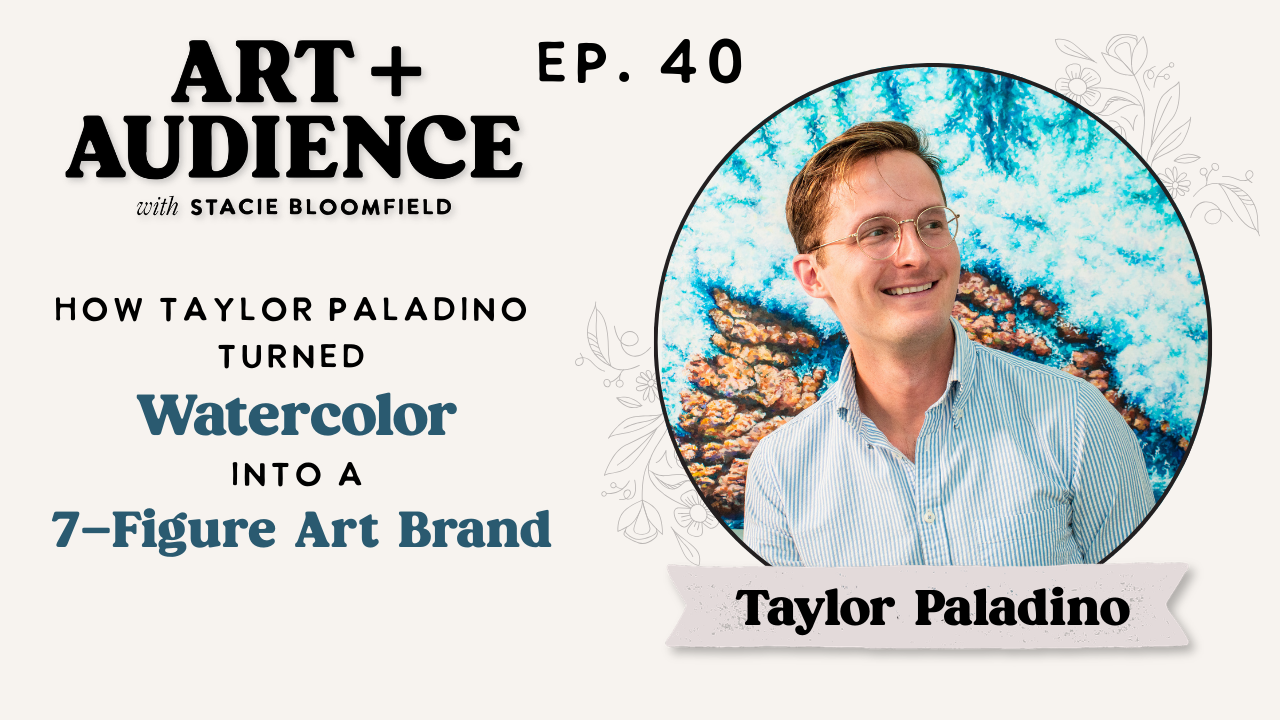
What does it take to turn watercolor paintings into a seven-figure art brand? Ben Taylor Paladino took a year off from Stanford during COVID, set up a booth at a Dallas farmers market, and figured out how to sell his art face-to-face as a self-described introvert. That experience changed everything.
In this episode, Stacie Bloomfield sits down with Ben to unpack the decisions that built his business — from a mahjong tile collaboration with Oh My Mahjong that put him on the map, to a Christmas market strategy that drives one-tenth of his annual revenue in five days, to the operational systems that allow him to offer 6,500 SKUs without being buried in inventory. With over $1 million in annual sales, a 100-page wholesale catalog, and a team of retired school teachers keeping it all running, Ben's story is a masterclass in how to grow a product-based art brand strategically without losing the joy of making the work.
RESOURCES MENTIONED IN THIS EPISODE:
- @taylor.paladino on Instagram — Behind-the-scenes peeks at new watercolor designs, holiday launches, mahjong collaborations, and the real-life moments behind a fast-growing art brand.
- The Artist's Side Hustle — Stacie's Hay House book on building real income from your art, including product-based and wholesale strategies that parallel what Ben built.
- Side Hustle Society — The community Stacie built for artists navigating exactly the kinds of product and pricing decisions Ben discusses in this episode. Waitlist is always open.
HERE ARE THE 5 KEY TAKEAWAYS FROM THIS EPISODE:
1️⃣ Selling at a Farmers Market Teaches You What Analytics Never Can
Ben Taylor Paladino's farmers market experience during his year off from Stanford became the foundation of his entire business. Face-to-face selling — watching which pieces people picked up, which ones they put back, and what made someone stop walking — gave him real-time market research that no dashboard could replicate. He learned what people actually wanted, not what he assumed they wanted.
The lesson was immediate and specific: nobody was buying the roses. Everybody was buying the golden retriever. That kind of direct feedback is impossible to fake or approximate online. And it was also where The Container Store found him — a buyer discovered Ben at the Dallas farmers market and that's how that wholesale account started. Not through a pitch deck. Not through a cold email. Through a folding table.
For introverted artists especially, in-person selling can feel like the last thing you want to do. Ben is upfront that he's an introvert. But his story is a strong argument for doing it anyway. The feedback loop is honest. A customer who lingers over a tea towel but doesn't buy is telling you something. A piece that sells out every week is telling you something louder. That information is worth more than months of online guessing.
2️⃣ The Right Collaboration Accelerates Your Reach — But Patience Is Required
The mahjong tile collaboration with Oh My Mahjong that put Ben on the map took about a year from first conversation to launch. When it came out, it made waves. Ben credits it as one of the moments that genuinely expanded his audience and positioned his brand in a new category. But it didn't happen fast, and it didn't happen by accident — it happened because his portfolio was already clear, distinctive, and ready to be applied to something unexpected.
For artists building licensing and product businesses, Ben's story is a reminder to stay open to unusual categories. Your art doesn't have to stay where you first placed it. The question isn't just "who would put my art on a card?" — it's "what haven't I tried yet that might be exactly right?" Ben's willingness to say yes to an unusual format, and to stay patient through a year-long development process, created a moment that grew his entire audience.
3️⃣ 6,500 SKUs Is an Operational Achievement, Not Just a Creative One
Ben offers approximately 6,500 SKUs across his product line — built from roughly 800 designs, each of which may exist as a greeting card, a boxed set, a notepad, a tea towel, and more. The sheer volume is staggering. But the reason he can manage it without collapsing is that he built the operational infrastructure to support it: print-on-demand relationships, in-house printing on leased digital presses, intentional inventory decisions, and data management systems that keep everything trackable.
The in-house printing move is especially worth noting. By leasing digital presses and printing paper goods himself, Ben can print to order rather than stocking thousands of units that may not sell. That decision freed up cash and eliminated the inventory risk that buries so many product-based artists. Creative range without operational support collapses into chaos. Creative range with the right systems becomes a competitive advantage.
As his business has grown, the hardest part isn't painting. It's barcodes, inventory tracking, data management, and the systems underneath the creative work. Stacie Bloomfield sees this consistently across the artists she works with: the ones who scale sustainably are the ones who treat operations as seriously as art.
4️⃣ Start with Retail, Add Wholesale Later — In That Order
Ben's advice for artists just starting out is clear: start with retail. Sell at farmers markets, pop-ups, or holiday shows at full retail prices. Learn what resonates. Build proof of concept. Wholesale can come later once you have momentum and systems in place.
His own business reflects exactly this sequence. Retail — his website and in-person holiday markets — often delivers higher profit margins than wholesale even now. At the Nutcracker Market in Houston, he does roughly one-tenth of his annual business in just five days. That is the power of getting in front of people who are ready to buy, at full price, with no middleman.
Wholesale provides consistency — predictable buying seasons, repeat orders, accounts like The Container Store and Dillard's — but it's a volume game with slimmer margins and more operational complexity. Building the retail side first gives you the proof of concept, the sales history, and the pricing confidence to enter wholesale from a position of strength rather than desperation.
5️⃣ The Best Team Members Aren't Always Found Where You'd Expect
When Ben needed help during a busy holiday season, he connected with The Senior Source — a Dallas nonprofit — and built a team that includes retired school teachers. His assessment: you will never find anyone who works harder than a school teacher.
That story matters beyond the detail itself. As the business grows, Ben is actively working toward becoming a creative director — someone who leads and directs rather than doing every operational task himself. His dream collaboration is designing a scarf for Hermès. The systems he's building, the team he's assembling, the operational infrastructure he's put in place — all of it is in service of that creative future. The business exists to support the art, not the other way around.
MORE FROM BEN TAYLOR PALADINO
Find Ben and his work here:
📸 Instagram: @taylor.paladino
SUBSCRIBE & REVIEW THE ART + AUDIENCE PODCAST
If this episode sparked something for you, the best way to support the show is to subscribe and leave a review on Apple Podcasts. It takes 30 seconds and helps other artists find us. New episodes drop every week. Subscribe so you never miss one — and if this sounds like something a creative friend needs to hear, share it with them.
Frequently Asked Questions About Building a Product-Based Art Business
Should artists start with retail or wholesale?
Start with retail. Ben Taylor Paladino's advice is clear: get in front of people at farmers markets, pop-ups, or holiday shows at full retail prices. Learn what resonates, build proof of concept, and develop the sales history and pricing confidence you'll need before entering wholesale. Wholesale comes later — once you have momentum and operational systems in place to support it.
How do you manage a large product catalog as an artist?
The key is operational infrastructure under the creative output. Ben Taylor Paladino manages 6,500 SKUs by leasing digital presses to print paper goods in-house (eliminating excess inventory), making intentional decisions about product categories, and building data management systems that keep everything trackable. Without systems, catalog breadth becomes chaos. With the right systems, it becomes a competitive advantage — more options for more customers, without more strain on the artist.
Are Christmas markets and holiday shows worth it for product-based artists?
Yes — when approached as a serious revenue strategy. Ben Taylor Paladino does roughly one-tenth of his annual business at the Nutcracker Market in Houston in just five days. The keys are preparation: the right product selection, pricing for in-person impulse buying, strong visual display, and systems to capture customer relationships beyond the event itself. Artists who treat holiday markets as a core revenue channel — not just a fun seasonal event — can generate significant concentrated income in a short window.
About Stacie Bloomfield
Stacie Bloomfield is the founder of Gingiber, a surface pattern design and art licensing brand she built from her dining room table into a multimillion-dollar business with products in 1,400+ brick-and-mortar stores. She has earned $500K+ through art licensing and has taught 5,000+ artists how to build real income from their work.
She is the author of The Artist's Side Hustle (Hay House), a Moda fabric designer, and the host of the Art + Audience podcast. Her programs — including Side Hustle Society, Leverage Your Art, and the Art Licensing Pitch Playbook — help artists at every stage turn their creativity into consistent income.
StacieBloomfield.com needs the contact information you provide to us to contact you about our products and services. You may unsubscribe from these communications at anytime. See our privacy policy for terms and conditions and to learn how we protect your data.