From Coding Software to Designing Fabric: The Career Pivot That Worked for Mel Armstrong
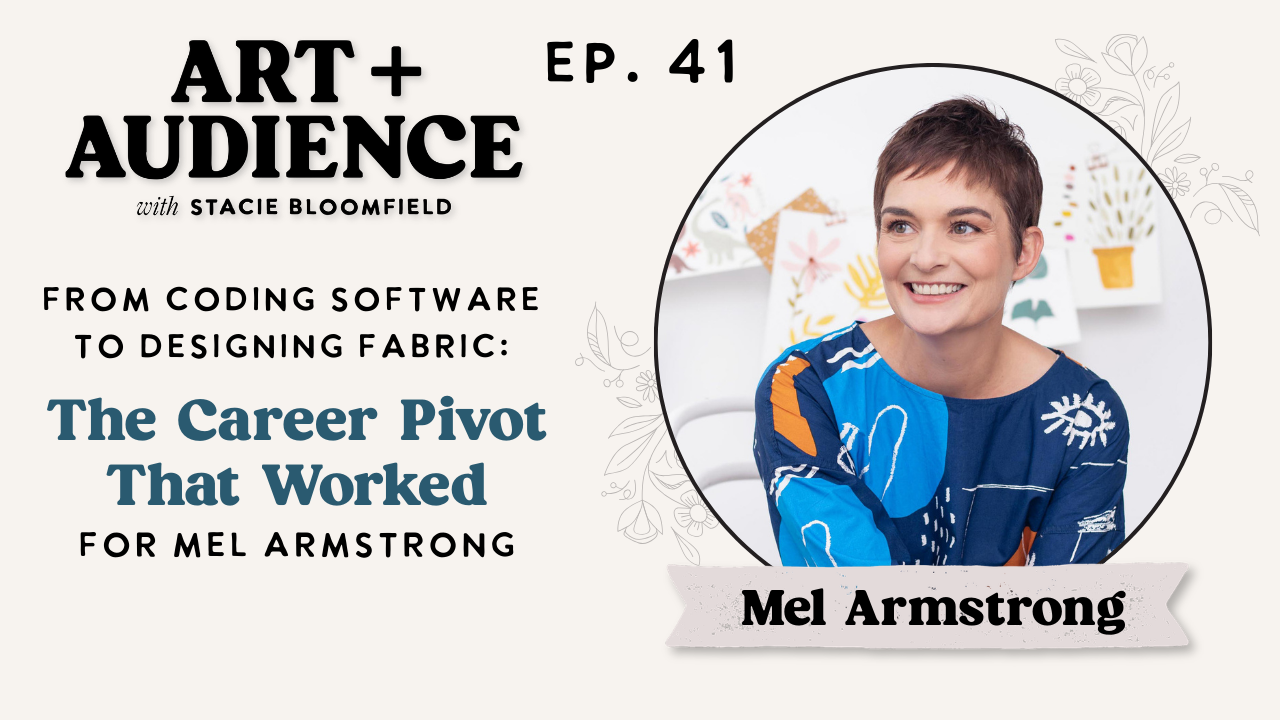
What happens when a software engineer goes looking for fabric and ends up building a thriving creative career? Mel Armstrong’s creative career didn’t begin with a perfect plan, it began with curiosity, persistence, and a willingness to follow unexpected opportunities.
In this episode of Art + Audience, Stacie sits down with New Zealand-based surface pattern designer, children’s book illustrator, educator, and creative community leader Mel Armstrong. What unfolds is an honest and inspiring conversation about career pivots, accidental opportunities, creative persistence, and the beautiful impact of building a life around art.
Mel’s story is a reminder that creative careers do not always begin with a grand master plan. Sometimes they begin with a Google search, a season of curiosity, and the courage to keep going.
From Software Engineering to Surface Pattern Design
Before Mel Armstrong built the creative career she’s known for today, she was working as a software engineer in Sydney. Even then, she found herself drawn to the visual side of her work, the design, the interface, the part that made things feel beautiful and inviting.
Her path into surface pattern design began during pregnancy, when she went looking for gender-neutral fabric to sew clothes for her baby and couldn’t find what she wanted. So she asked a simple question: could she design her own?
That question led her to Spoonflower, where she discovered the world of custom fabric design. With her existing Photoshop skills and a growing curiosity, Mel started teaching herself. Within a few years, she had won a design scholarship, signed with an agent, and slowly began transitioning out of software work and into art full time.
What’s especially encouraging about Mel’s story is that it wasn’t an overnight leap. It was gradual. She held onto client work while building her illustration business on the side, allowing the creative side of her career to grow steadily before fully stepping into it.
The Power of Doing It Gradually
One of the most relatable parts of Mel’s journey is how realistic it was. She didn’t abandon everything at once. She built her creative career while raising children and continuing to earn income through other work.
That season came with challenges, especially around time and energy. Like so many artists in the early stages, Mel was balancing caregiving, client work, and creative dreams all at once. For a number of years, the art side of her business did not bring in much money. What carried her through was persistence.
Her story reinforces an important truth for aspiring artists: sometimes the most sustainable path is the slow one. Building your creative business alongside another income stream can relieve pressure and give your art the room it needs to grow.
Falling Into Children’s Book Illustration
Another unexpected chapter in Mel’s career was children’s books.
At the time, she was represented by an agent, and a publisher discovered a cat design of hers on Spoonflower. That design led to an opportunity to illustrate a children’s book, something Mel had never done before.
Even though she didn’t feel fully prepared, she said yes.
With the support of a strong book designer and the experience she had already been building through online classes and portfolio work, Mel illustrated her first book. That book went on to win a Rubery Award in the children’s category, giving her a huge confidence boost and opening the door to more opportunities.
Since then, she has illustrated around 16 or 17 books.
What stands out here is Mel’s humility. Even with all of that experience, she still talks openly about learning, improving, and wanting to grow. That mindset, one of openness and continual development, is part of what makes her so compelling.
What It Really Takes to Build a Career in Children’s Books
Mel also offers a refreshingly honest look at the business side of children’s book illustration.
She explains that making a full-time living from books alone would likely require illustrating more than one or two books per year, perhaps closer to six, depending on the types of publishers and contracts involved. Larger publishers may pay more up front, while long-term royalties can build over time.
One especially fascinating insight she shared is how children’s book income can come from multiple streams, not just book sales. In Australia and New Zealand, authors and illustrators may also receive royalties through public lending and library use, as well as through other rights channels such as audiobooks.
It’s a helpful reminder that creative income is often layered. Sometimes the most sustainable careers are built not on one giant breakthrough, but on multiple streams that grow over time.
Building a Thriving Online Community
In addition to her work as an illustrator and designer, Mel has become a trusted teacher and community builder for surface pattern designers around the world.
Like many parts of her career, teaching happened unexpectedly. Skillshare reached out and asked whether she wanted to teach a class. At first, she doubted herself. But she remembered a time from her software engineering career when she had been asked to teach company directors how to use software, and discovered she was actually very good at it.
So she gave it a try.
Her first Skillshare class took off, and from there she continued teaching, mentoring, and eventually building a private online community filled with hundreds of surface pattern designers. Inside that space, members participate in monthly challenges, live Q&As, and conversations that go far beyond technique.
The result is more than an educational platform. It’s a genuine creative community.
Mel shared that one of the most rewarding parts of this work is watching relationships form between members, people from different parts of the world becoming creative friends, collaborators, and support systems for one another.
How Community Changes the Leader, Too
One of the most meaningful moments in the episode comes when Stacie asks Mel how leading a community has changed her.
Mel reflects that it has made her more compassionate and widened her perspective. Her community includes people from many countries, ages, and backgrounds, from teenagers to artists in their eighties. Getting to know them has deepened her curiosity about people and helped her become a more empathetic leader.
That insight feels especially powerful in a creative world that can sometimes feel isolating. Art businesses are often built solo, but sustainable creative lives are rarely built alone.
Curiosity as a Creative Superpower
Throughout the conversation, one theme keeps resurfacing: Mel is someone who says yes to possibility.
Whether it was fabric design, children’s books, teaching, YouTube, or community building, many of the biggest parts of her career began as side roads she chose to explore. She describes herself as someone who wants to give things a go, even if they don’t work out.
That willingness to try has shaped her entire life.
She also shares that she has ADHD, and describes her brain as having “too many tabs open”, a phrase many creatives will instantly recognize. But instead of treating that curiosity like a flaw, Mel has learned how to channel it into exploration, experimentation, and growth.
There’s something deeply freeing in that. Not every opportunity has to become a lifelong path. Sometimes, trying something teaches you what’s next.
The Hard Lesson: Learn the Business Side
When Stacie asks about the biggest lesson Mel has learned, Mel doesn’t hesitate: the business side matters.
Like many creatives, she jumped into self-employment without fully understanding taxes, finances, and the practical realities of running a business. That led to costly mistakes early on, including a huge tax bill.
Now, she emphasizes that learning the business side is just as important as developing artistic skill. In fact, it’s something she teaches inside her courses because she knows firsthand how easy it is to overlook.
This is such an important takeaway for artists. Passion and talent matter, but so do systems, financial literacy, and understanding how your business actually works.
Rooted in Family, Fueled by Support
When asked who has been cheering her on through all of this, Mel points to her family.
She shares a sweet story about her daughter proudly telling friends that her mom is an artist who makes money from art. Her daughter even writes books for Mel to illustrate. It’s a small but beautiful glimpse into how creative work ripples outward and shapes the people closest to us.
That support has mattered through the hard seasons, especially the moments when Mel questioned whether she’d have to leave her art career and get a conventional job. Instead, she kept going.
And that may be one of the clearest messages of this entire episode: persistence matters, even when the path is winding.
Final Thoughts
Mel Armstrong’s story is full of encouragement for artists who are still figuring it out.
You do not need a perfect five-year plan.
You do not need to feel fully ready.
You do not need to do it all at once.
What you do need is curiosity, persistence, and a willingness to keep learning.
Mel has built a career that blends art, education, books, community, and creativity in a way that feels both expansive and deeply human. She reminds us that sometimes the most meaningful creative lives are built not by forcing a path, but by following possibility with intention.
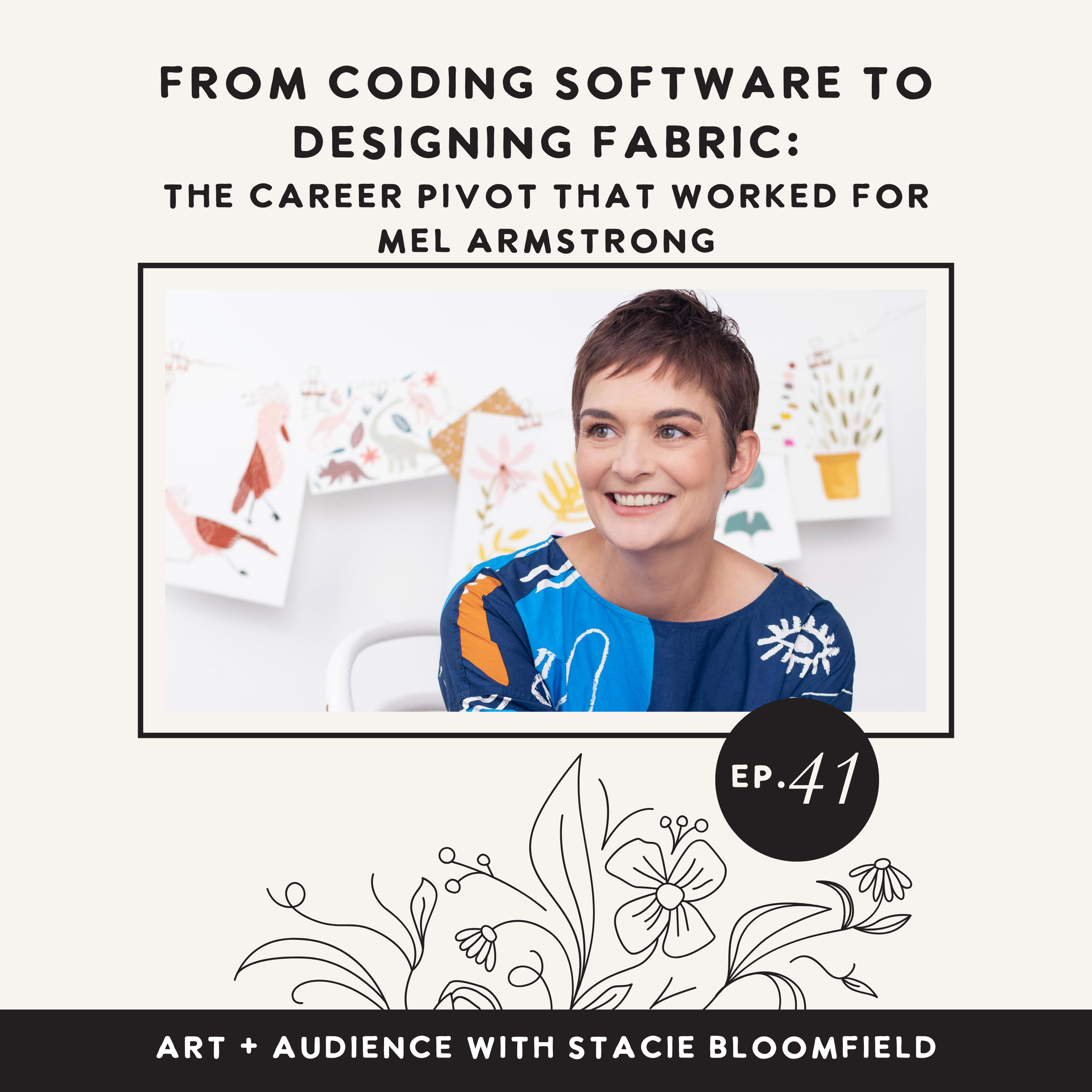
To learn more about Mel, her artwork, her community, and her educational resources, visit her website at melarmstrong.com.
If this episode resonated, share it with your fellow artists. Don’t forget to subscribe, rate, and review the Art + Audience Podcast. Follow Stacie on Instagram @gingiber | @leverageyourart.
Get a copy of Stacie’s book: The Artist's Side Hustle. OUT NOW!
If you have questions about your own art journey? Call the Art + Audience hotline at (479) 966-9561, and Stacie might answer your question in a future episode!
StacieBloomfield.com needs the contact information you provide to us to contact you about our products and services. You may unsubscribe from these communications at anytime. See our privacy policy for terms and conditions and to learn how we protect your data.