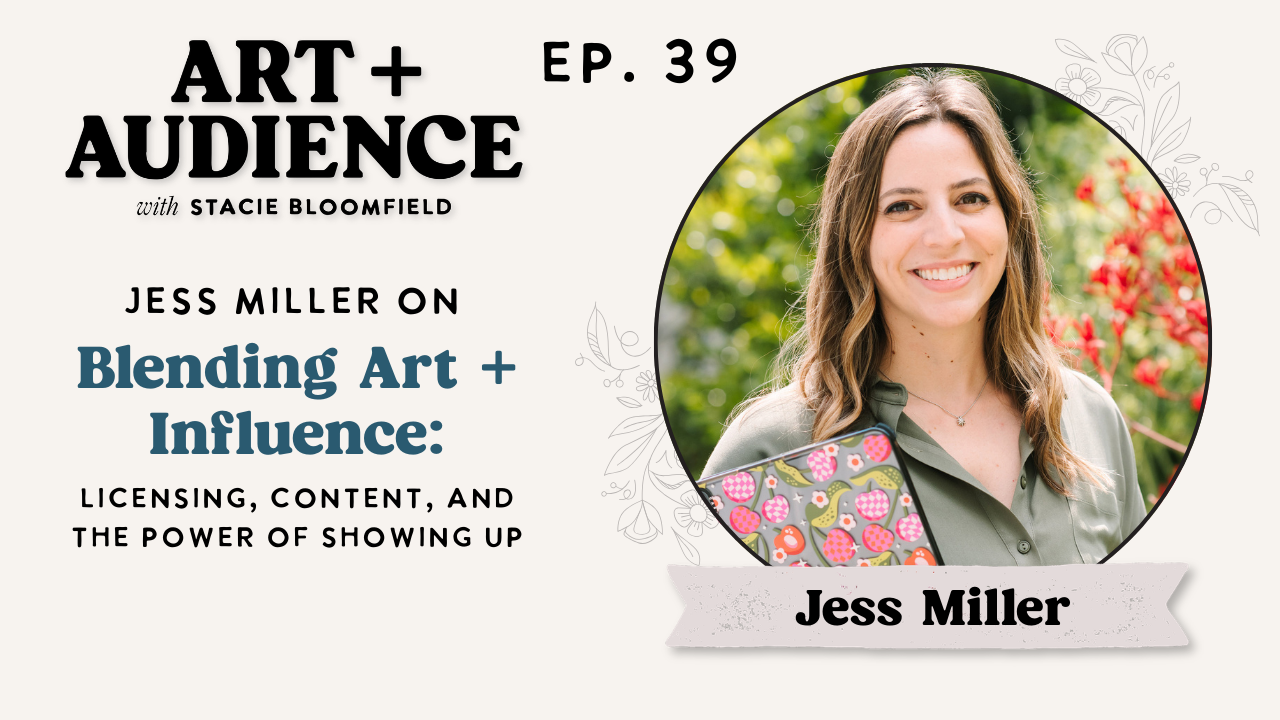
Jess Miller on Blending Art + Influence: Licensing, Content, and the Power of Showing Up
🎧 Listen to this episode: Apple Podcasts
What happens when you mix illustration, consistency, and a willingness to charge what your work is actually worth? You get Jess Miller — an artist who built a thriving, multi-stream business by showing up every day and treating content creation like the legitimate revenue channel it is.
In this episode, Stacie Bloomfield sits down with Jess to talk about how she went from drawing every day during the pandemic to landing brand partnerships with Adobe, Casetify, and Michaels — and what artists consistently get wrong about content creation, income diversification, and knowing their value. Jess also shares details about her debut coloring book, Art of the Zodiac, published by Page Street Publishing. This one is honest, practical, and full of things working artists can use immediately.
RESOURCES MENTIONED IN THIS EPISODE:
- @jessmillerdraws on Instagram — Where Jess shares her illustration work, creative process, and the behind-the-scenes of a modern art business.
- Art of the Zodiac by Jess Miller — Her debut coloring book, published by Page Street Publishing. Available wherever books are sold, including Barnes & Noble and Amazon.
- Art Licensing Pitch Playbook — If this episode got you thinking about licensing, Stacie's Pitch Playbook is the next step. It covers finding the right companies, writing the pitch, and following up.
- The Artist's Side Hustle — Stacie's Hay House book on building real income from your art across multiple streams — exactly the approach Jess has built her business on.
HERE ARE THE 5 KEY TAKEAWAYS FROM THIS EPISODE:
1️⃣ Content Creation and Art Licensing Are Not Competing — They Feed Each Other
The artists who build the most resilient businesses aren't choosing between licensing and content creation — they're using each to amplify the other. Jess Miller's brand partnerships with Adobe, Casetify, and Michaels didn't happen because she cold-pitched them out of nowhere. They happened because her consistent content made her visible, credible, and easy to say yes to. The social presence built the case; the licensing closed the deal.
For artists who feel like they have to pick a lane — "I'm a licensor" or "I'm a content creator" — Jess's story is a direct counter. You can be both. The combination is often stronger than either one alone. Your content attracts brands that want to work with artists who already have an audience. Your licensing deals give your content credibility and proof of commercial viability. The two grow together when you let them.
2️⃣ UGC Is a Real Revenue Stream — and Most Artists Don't Know It Exists
Jess breaks down something most artists misunderstand about content creation: it isn't always about what shows up on your own feed. User-generated content (UGC) — hands-only crafting videos, software tutorials, branded demos — can be produced for a company without ever being posted to your own account. Jess has built real income this way: creating brand content that does the job without requiring a large personal following.
Her distinction is worth internalizing. There's a difference between creating art and creating content. And both have a market value. If you've been thinking content creation requires you to be "famous" on social media first, Jess's experience with UGC is proof that isn't true. You can start generating income from branded content as soon as you understand the format and know how to pitch it.
3️⃣ Brand Deals Range from $2,500 to $25,000 — Know Your Rate Before You Reply
Jess is one of the rare artists who talks openly about money, and what she shares is genuinely useful. Her brand partnerships have ranged from $2,500 to $25,000 depending on scope, usage rights, and deliverables. She publishes her annual income breakdown as percentages — not dollar amounts — every year, openly showing how the revenue mix evolves and helping other artists demystify what a modern art business actually looks like financially.
Her advice: don't say yes to $150 reels. Know what your work is worth before a brand reaches out, not after. If you wait until you're in the conversation to figure out your rate, you're already negotiating from a weak position. Understanding the market — what brands pay, what deliverables they expect, and where your rate should sit — is part of the job.
Stacie Bloomfield's Art Licensing Pitch Playbook covers exactly this: how to find the right companies, how to write the pitch, and how to follow up. If licensing is on your radar after this episode, that's the next step.
4️⃣ Build One Income Stream at a Time, Not All Five at Once
Jess runs licensing, content partnerships, UGC, teaching, and publishing simultaneously — but she's clear that this didn't happen all at once. She built each stream over time, starting with what she was already doing and adding new channels as she understood her capacity and her market. The diversity is the result of years of incremental building, not a simultaneous launch.
The artists who burn out on multiple income streams are almost always the ones who try to run all of them before any of them are stable. Stacie Bloomfield's framework — build one stream to stability before starting the next — is exactly the sequencing that makes "multiple streams" sustainable rather than chaotic. Jess's business is what that looks like when it's working: each stream feeding the others, none of them underdeveloped, the whole system moving forward together.
5️⃣ Simple Tools and Batching Are the Real Secret to Consistency
Jess's approach to content production is refreshingly unsexy: a second phone, a $20 tripod, and filming days where she batches content in advance. There's no elaborate studio setup, no professional crew, no waiting until everything is perfect. She shoots what she has, in the space she has, with the gear that works.
That simplicity is the point. Content creation becomes unsustainable when it requires conditions that don't exist every day. When you set up a system that works with your actual life — your actual studio, your actual schedule — you can stay consistent. And consistency, more than any single viral moment, is what builds an audience brands want to partner with. Jess has had viral videos. She's also clear that virality is a bonus, not a strategy. Consistency is the strategy.
MORE FROM JESS MILLER
Find Jess and her work here:
📸 Instagram: @jessmillerdraws
SUBSCRIBE & REVIEW THE ART + AUDIENCE PODCAST
If this episode sparked something for you, the best way to support the show is to subscribe and leave a review on Apple Podcasts. It takes 30 seconds and helps other artists find us. New episodes drop every week. Subscribe so you never miss one — and if this sounds like something a creative friend needs to hear, share it with them.
Frequently Asked Questions About Art Licensing and Content Creation
Can you do both art licensing and content creation at the same time?
Yes — and for many artists, combining both is more powerful than choosing one. Social media content builds visibility and credibility with the brands you want to license to, while licensing deals give your content authority and proof of commercial viability. Jess Miller's partnerships with Adobe, Casetify, and Michaels are a direct result of showing up consistently on social media while actively pursuing licensing deals in parallel.
What is UGC and can artists make money from it?
UGC (user-generated content) is branded content created for companies that may never appear on your own social feed — hands-only tutorials, product demos, crafting videos. Artists can generate real income from UGC without needing a large personal following. Jess Miller has built this into one of her revenue streams. The key is understanding the format, knowing how to pitch it to brands, and pricing your work appropriately from the start.
How many income streams should an artist have?
Build one stream to stability before starting the next. The number isn't the goal — the foundation is. Most working artists eventually operate with 3–5 income streams: licensing, content and brand partnerships, digital products or teaching, product sales, and community or membership revenue. But the artists who burn out are the ones who launch all five at once. Sequence matters more than speed.
About Stacie Bloomfield
Stacie Bloomfield is the founder of Gingiber, a surface pattern design and art licensing brand she built from her dining room table into a multimillion-dollar business with products in 1,400+ brick-and-mortar stores. She has earned $500K+ through art licensing and has taught 5,000+ artists how to build real income from their work.
She is the author of The Artist's Side Hustle (Hay House), a Moda fabric designer, and the host of the Art + Audience podcast. Her programs — including Side Hustle Society, Leverage Your Art, and the Art Licensing Pitch Playbook — help artists at every stage turn their creativity into consistent income.
StacieBloomfield.com needs the contact information you provide to us to contact you about our products and services. You may unsubscribe from these communications at anytime. See our privacy policy for terms and conditions and to learn how we protect your data.