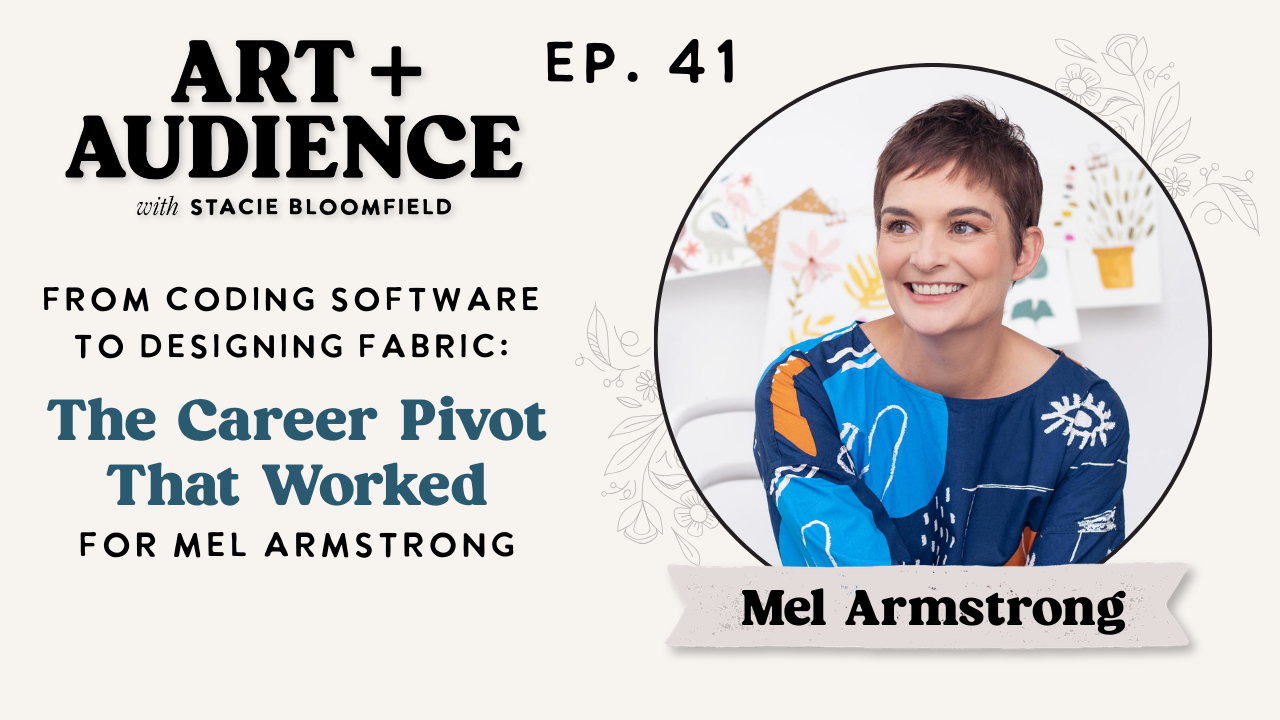
From Coding Software to Designing Fabric: The Career Pivot That Worked for Mel Armstrong
🎧 Listen to this episode: Apple Podcasts
What happens when a software engineer goes looking for fabric she can't find and decides to design it herself? For Mel Armstrong, that one question launched a career she couldn't have planned — and a life built entirely around art, illustration, teaching, and community.
In this episode, Stacie Bloomfield sits down with New Zealand-based surface pattern designer, children's book illustrator, educator, and community leader Mel Armstrong. Mel's path into the creative world began not in an art school studio but in a software engineering role in Sydney. She shares how she gradually transitioned out of tech, illustrated 16+ children's books (one of which won a Rubery Award), built a thriving global creative community, and learned the business lessons that almost cost her early on. This is a refreshing, honest conversation about what it actually takes to build a creative life — and why the winding path is often the right one.
RESOURCES MENTIONED IN THIS EPISODE:
- Mel Armstrong — Mel's creative home base, featuring her surface pattern design portfolio, illustration work, and educational resources.
- Leverage Your Art — For artists making a career pivot into surface pattern design, Stacie's course covers every step from building a marketable portfolio to landing licensing deals.
- The Artist's Side Hustle — Stacie's Hay House book for artists who want to build real income from their work while juggling real life. The business foundations Mel wished she'd had earlier.
HERE ARE THE 5 KEY TAKEAWAYS FROM THIS EPISODE:
1️⃣ The Best Creative Careers Often Start with a Personal Problem You Decide to Solve
Mel Armstrong's path into surface pattern design began during pregnancy. She was looking for gender-neutral fabric to sew clothes for her baby and couldn't find what she wanted. So she asked a simple question: could she design her own? That question led her to Spoonflower — and from there, to a full creative career.
For artists still waiting for the right reason to start, Mel's origin story is worth sitting with. The most authentic creative work often grows out of something personal: a gap you noticed, a need you felt, a thing you wanted that didn't exist. You don't need a grand plan or a formal credential. You just need to start filling the gap. Mel had Photoshop skills from her engineering career and a growing curiosity. That was enough.
2️⃣ Gradual Transitions Are More Sustainable Than Big Leaps
Mel didn't quit software engineering the day she discovered she could design fabric. She built her creative career alongside her existing work — gradually, while raising children and continuing to earn income through other means. For a number of years, the art side of her business didn't bring in much money. What carried her through was persistence, not a dramatic all-or-nothing jump.
This approach is more sustainable than it gets credit for. Building alongside another income stream relieves pressure and gives your creative work the room it needs to grow. The goal isn't to make a great leap — it's to make consistent progress until the creative income is real enough to stand on. Mel's trajectory took her from Spoonflower to a design scholarship, to signing with an agent, to transitioning out of software work full time. Each step built on the one before it.
For artists who feel like they're not moving fast enough, Mel's story is a useful reset. The slow path is still a path. And sometimes it's the one that holds.
3️⃣ Saying Yes to Unexpected Opportunities Changes Your Career
Mel's entry into children's book illustration was entirely unplanned. A publisher discovered a cat design of hers on Spoonflower and reached out. Even though she had never illustrated a book before and didn't feel fully prepared, she said yes. With the support of a strong book designer and the experience she had been building through online classes, Mel illustrated her first book. That book went on to win a Rubery Award in the children's category.
Since then, she has illustrated around 16 to 17 books. None of that was in any version of her original plan.
The pattern across Mel's career is clear: the biggest chapters started as side roads she was willing to explore. Whether it was fabric design, children's books, teaching on Skillshare, or building a private online community, each started with curiosity and a willingness to try. She describes herself as someone with ADHD — "too many tabs open," she says — but instead of treating that curiosity like a flaw, she channels it into exploration. Not every side road has to become a lifelong path. Sometimes, trying something teaches you what's next.
4️⃣ Leading a Community Transforms You as Much as It Transforms the Members
Beyond her illustration and design work, Mel has become a trusted teacher and community builder for surface pattern designers around the world. Her private online community includes members from many countries, ages, and backgrounds — from teenagers to artists in their eighties — who participate in monthly challenges, live Q&As, and conversations that go far beyond technique.
When Stacie asks Mel how leading that community has changed her, her answer is quietly powerful: it made her more compassionate and widened her perspective. Getting to know people from such different backgrounds and life stages deepened her curiosity about people and helped her become a more empathetic leader.
Stacie Bloomfield built Side Hustle Society on the same conviction: the artists who don't burn out, who keep going through the hard seasons, are almost always the ones with real community around them. Not an audience — a community. People who know what you're building, who celebrate your wins, and who are there when things get hard. Mel's experience is proof that building that community pays back in ways that compound over years.
5️⃣ Learn the Business Side Before It Teaches You the Expensive Way
When Stacie asks Mel about the biggest lesson she's learned, Mel doesn't hesitate: the business side matters. Like many creatives, she jumped into self-employment without fully understanding taxes, finances, and the practical realities of running a business. That led to costly mistakes early on — including a significant unexpected tax bill.
Now, she teaches the business side inside her courses because she knows firsthand how easy it is to overlook. Passion and talent matter enormously. But so do systems, financial literacy, and a clear understanding of how your business actually works. Creative skill gets you in the door. Business knowledge keeps you there.
The good news: this is learnable. Mel figured it out the hard way. You don't have to. The Artist's Side Hustle was written specifically for artists who want to build sustainable income without the expensive surprises that come from skipping the business fundamentals.
MORE FROM MEL ARMSTRONG
Find Mel and her work here:
🌐 Website: melarmstrong.com
SUBSCRIBE & REVIEW THE ART + AUDIENCE PODCAST
If this episode sparked something for you, the best way to support the show is to subscribe and leave a review on Apple Podcasts. It takes 30 seconds and helps other artists find us. New episodes drop every week. Subscribe so you never miss one — and if this sounds like something a creative friend needs to hear, share it with them.
Frequently Asked Questions About Career Pivots into Creative Work
Can you become a surface pattern designer without an art degree?
Yes — Mel Armstrong transitioned from software engineering into surface pattern design with no formal art training. What she brought was existing Photoshop skills, genuine curiosity, and the persistence to keep learning. The surface pattern design industry rewards artists who have a distinctive style and understand how to build a business around it — neither of which requires a degree. What helps most is making work consistently, learning from artists who are ahead of you, and staying in the process long enough for things to compound.
How do you transition from a corporate career into a creative one without losing everything?
Keep your current income while building the creative side — don't jump until the creative income is real. Mel Armstrong held onto other income while her illustration and design business grew. The skills from your previous career almost always transfer in unexpected ways: Mel's engineering background gave her systems thinking, comfort with learning new tools, and a structured approach to building a business. You're not starting from zero. You're bringing everything you've already built into a new direction.
How do you build resilience as a creative entrepreneur?
Stay in the process even when results aren't visible yet. Mel Armstrong describes seasons where she questioned whether she'd have to leave her art career and get a conventional job. Instead, she kept going. Every slow month, every decision made with incomplete information, every unexpected challenge you figure out — these build the foundation you'll draw on when something genuinely hard arrives. The reps you're doing now matter, even when you can't see the compound effect yet.
About Stacie Bloomfield
Stacie Bloomfield is the founder of Gingiber, a surface pattern design and art licensing brand she built from her dining room table into a multimillion-dollar business with products in 1,400+ brick-and-mortar stores. She has earned $500K+ through art licensing and has taught 5,000+ artists how to build real income from their work.
She is the author of The Artist's Side Hustle (Hay House), a Moda fabric designer, and the host of the Art + Audience podcast. Her programs — including Side Hustle Society, Leverage Your Art, and the Art Licensing Pitch Playbook — help artists at every stage turn their creativity into consistent income.
StacieBloomfield.com needs the contact information you provide to us to contact you about our products and services. You may unsubscribe from these communications at anytime. See our privacy policy for terms and conditions and to learn how we protect your data.