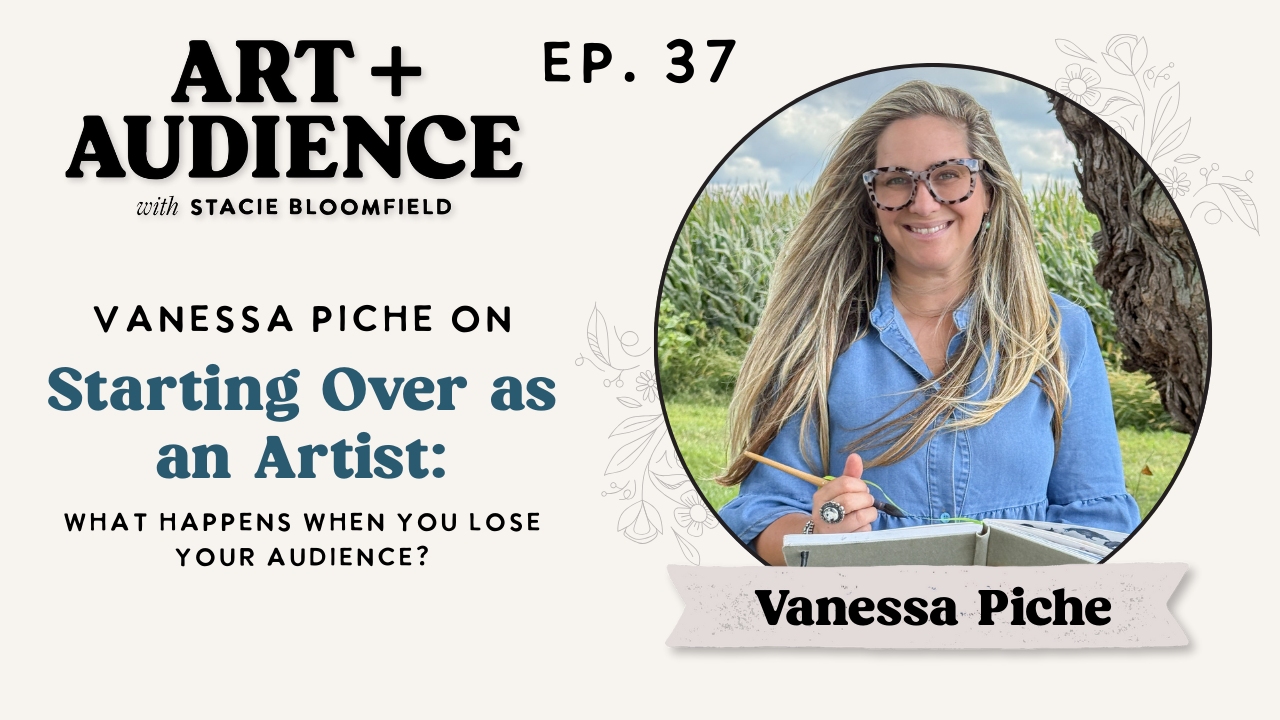
Vanessa Piche on Starting Over as an Artist: What Happens When You Lose Your Audience?
🎧 Listen to this episode: Apple Podcasts
What do you do when the audience you spent years building suddenly disappears? For painter Vanessa Piche, that question stopped being hypothetical when she packed up her Rhode Island art business — the festivals, the brick-and-mortar store, the t-shirt line — and moved to an inherited farm in Indiana. Everything that used to work, didn't anymore.
In this episode of the Art + Audience podcast, Stacie Bloomfield sits down with Vanessa for a conversation that's less strategy session and more solidarity. If you're rebuilding right now — a new city, a new chapter, a shifting algorithm — this one's for you.
Stacie built Gingiber from her dining room table into a $2M+ art licensing brand, and she's watched this kind of rebuild happen from both sides. What she and Vanessa figured out together matters for every artist who feels the ground shifting beneath them.
RESOURCES MENTIONED IN THIS EPISODE:
- vanessapiche.com — Vanessa's portfolio of oil paintings and the story of her evolving art business.
- @vanessapiche on Instagram — Follow her journey of building something new on an Indiana farm.
- The Artist's Side Hustle — Stacie Bloomfield's Hay House book, written for artists navigating business during a full life. Practical, honest, and everything Instagram doesn't teach you.
HERE ARE THE 5 KEY TAKEAWAYS FROM THIS EPISODE:
1️⃣ Building an Audience Online Feels Harder Than Ever — and You're Not Imagining It
Organic reach on Instagram has dropped dramatically, and what used to build an email list — lead magnets, opt-ins, even ads — is getting ignored at rates artists haven't seen before. Vanessa and Stacie name this out loud, because pretending it isn't happening doesn't help anyone.
The honest truth is that the playbook that built your first audience may not build your next one. That doesn't mean you've failed at marketing — it means the landscape changed, and fast. Algorithms shift. Platforms deprioritize organic content. TikTok is inconsistent. The first step forward is admitting that what worked in 2020 needs a rethink.
This isn't a reason to give up — it's a reason to get curious. Start by asking honestly: where are my people actually spending their time right now?
2️⃣ In-Person Trust Converts to Online Sales Long After the Event Ends
Customers who met Vanessa in person — at festivals, in her Rhode Island store — were significantly more likely to buy from her online, and to buy again. Trust built face-to-face doesn't evaporate when the event ends. It follows buyers home.
Stacie points out that many serious art collectors and buyers are 45+, a demographic that has never fully moved its purchasing behavior online. If they're not on TikTok, where are they? At art fairs, in boutiques, at events where they can see the work and meet the maker. That's where the relationship starts — and where the repeat purchase follows.
Don't write off in-person as old-fashioned. It may be your most reliable pipeline right now for turning a stranger into a loyal customer.
3️⃣ The Pendulum May Be Swinging Back to Real-Life Community
Vanessa and Stacie float an idea that feels both nostalgical and forward-thinking: maybe it's time to get back in person — not as a consolation prize for when online fails, but because human connection is the one thing algorithms can never replicate.
From selling art at horse shows to hosting retreats on Vanessa's Indiana farm-turned-art-studio, the conversation turns hopeful. What if rebuilding your audience means leaning back into what worked before the internet took over? What if your next hundred customers are at a local market, not in your feed?
This is a genuine strategic question worth sitting with — especially for artists who have a body of work, a clear style, and something real to show up with.
4️⃣ Name Your Honest Failures — Then Brainstorm Forward
Vanessa doesn't protect her image in this episode. She lists what hasn't worked recently: lead magnets that flopped, a beautiful collection launch that didn't convert, story views on Instagram tanking. That honesty is what makes this conversation actually useful.
Naming what failed isn't the same as wallowing in it. Stacie and Vanessa use the failures as data — then shift immediately to brainstorming. Could outreach to TikTok accounts in the farm life or homesteading niche reach Vanessa's new local audience? What about combining live markets with livestreaming? The answers aren't clear yet — and that's okay. The commitment to keep experimenting, without spiraling into self-doubt, is the whole move.
5️⃣ "We've Always Had What We Needed" — Trust the Timing
As the episode closes, Stacie shares wisdom from a longtime friend: "We've always had what we needed when we needed it — even when it didn't feel like it in the moment."
If you're in a season of rebuilding, that's not a punishment. It's an invitation to figure out what's actually next. As Vanessa puts it: "We're on the side that's going to survive this, because we're willing to have the conversation and look at things differently." That willingness — to show up, stay curious, and keep going — is what separates artists who build something lasting from those who wait for the algorithm to fix itself.
You don't have to have it figured out. You just have to stay in the room.
MORE FROM VANESSA PICHE
Find Vanessa and her work here:
🌐 Website: vanessapiche.com
📸 Instagram: @vanessapiche
SUBSCRIBE & REVIEW THE ART + AUDIENCE PODCAST
If this episode sparked something for you, the best way to support the show is to subscribe and leave a review on Apple Podcasts. It takes 30 seconds and helps other artists find us. New episodes drop every week — subscribe so you never miss one, and share this with a creative friend who needs to hear it.
Frequently Asked Questions About Starting Over as an Artist
How do you rebuild an art audience after moving to a new city?
Start in person before you start online. When you move, your digital audience often doesn't follow — but a local art fair, boutique relationship, or community event can introduce you to buyers who will then follow you online. Vanessa Piche found that trust built face-to-face converted to repeat online buyers far more reliably than cold digital outreach ever did.
Why is organic reach on Instagram so hard for artists right now?
Instagram's algorithm increasingly deprioritizes organic posts from business accounts in favor of paid content and Reels. Artists who built audiences through consistent static posts or stories are seeing dramatically less reach for the same effort. This is a platform-wide shift, not a personal failure — and it's one of the core reasons Stacie Bloomfield encourages artists to build an email list that they actually own.
Should artists go back to in-person events instead of social media?
Not instead — alongside. In-person events build the kind of trust that makes someone a long-term buyer, not just a follower. Art fairs, markets, retreats, and wholesale relationships create customers who are more likely to buy from you again online because they already know and trust you. Social media still matters for visibility, but in-person is often where conversion happens fastest.
About Stacie Bloomfield
Stacie Bloomfield is the founder of Gingiber, a surface pattern design and art licensing brand she built from her dining room table into a multimillion-dollar business with products in 1,400+ brick-and-mortar stores. She has earned $500K+ through art licensing and has taught 5,000+ artists how to build real income from their work.
She is the author of The Artist's Side Hustle (Hay House), a Moda fabric designer, and the host of the Art + Audience podcast. Her programs — including Side Hustle Society, Leverage Your Art, and Art Licensing Pitch Playbook — help artists at every stage turn their creativity into consistent income.
StacieBloomfield.com needs the contact information you provide to us to contact you about our products and services. You may unsubscribe from these communications at anytime. See our privacy policy for terms and conditions and to learn how we protect your data.